


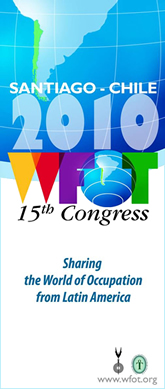

- WFOT Congress 2010 a resounding success!
Occupational Therapists from all around the world came to Santiago, Chile for the WFOT Congress 2010, May 4 - 7. Around 2000 colleagues spent four days together, learning, sharing, networking and celebrating occupational therapy. WFOT wishes to thank all those who attended and participated in Congress 2010, and all those who contributed to the organisation of such a successful event. We look forward to bringing you more news and photos from Congress over the coming months.
Sharon Brintnell, WFOT Executive Management Team and Team Chile
WFOT Congress 2010 Pictures
Latin American Occupational Therapy and Chile Landscapes
Congress Vision
The 15th WFOT World Congress focuses on contemporary perspectives in occupational therapy and occupational science. Many of these perspectives emerge from the historical roots of international practice while others reflect the thinking of current times. The Congress incorporates human rights as a necessary framework for the development of the science and occupational therapy. The Congress themes guide the presentations yet provide the flexibility for unique and refreshing viewpoints, evidence to support theory and practice policy development and most importantly to engage in comparative exercises across all aspects of occupational therapy and occupational science. The exploration of the forces acting on the profession’s knowledge and domains of practice is essential. Congress participants will participate in stimulating reflective dialogue about their practice and personal contexts as well as the emerging evidence which distinguishes Latin American practice.
Team Chile
- Alejandro Guajardo, Chile, Congress President
- Paola Méndez, Chile, Congress Vice President
- Marilyn Pattison, Australia, International Co-President – Executive Director WFOT
- Enrique Henny, Chile, International Co-President
- Daniela Castro, Chile, Secretariat
- Cristina Fernández, Chile, Academic Program Committee President
- Paola Méndez, Chile, Finances Committee President
- Enrique Henny, Chile, Public Relations & Marketing Committee President
- Francisca Espinosa, Chile Logistic Committee President
- Erna Navarrete, Chile, Social Events Committee President
- Eileen Jacard, Chile Student Program Committee President
- Jennifer Pascoe, Australia, WFOT Congress Project Officer
About Chile
Chile is situated between the Andes Mountains and the Pacific Ocean in a narrow stretch of land that is approximately 350 kilometers wide.
Chile currently has a population of more than 15 million people, and an annual population growth of 1.5%.
Contrast and diversity characterizes the geography of Chile. In the north, the climate conditions the existence of the most ardent desert in the world located in the Atacama region. In the center and the south of Chile however, green and fertile valleys produce quality fruits, vegetables, and wines that are enjoyed around the world.
The official language of Chile is Spanish; however, there are certain indigenous groups in the north of the country that still maintain their original language.
The Chilean diet comprises mainly meat, potatoes, maize, fruits and vegetables. The extended shores also provide Chileans with delicious fish and seafood such as salmon, trout, eel, sea scallops and lobsters.
For more information about Chile, go to www.visit-chile.org
About Santiago
Santiago is Chile's capital and the country’s largest city, and is situated at an elevation of 520 metres in the country's central valley.
Approximately two decades of uninterrupted economic growth have transformed Santiago into one of Latin America's most sophisticated metropolitan areas, with extensive suburban development, dozens of shopping malls, and impressive high-rise architecture.
The city also boasts some of Latin America's most spectacular infrastructure, such as the Santiago Metro and the sparkling new ‘Costanera Norte’, a freeway system that passes below downtown and connects the Eastern and Western extremes of the city in 15 minutes.
Santiago is headquarters to many important companies and is a regionally important financial center.
Santiago has a mild Mediterranean climate - relatively hot dry summers (November to March) with temperatures reaching up to 35 degrees celsius on the hottest days; winters (June to August) are more humid, with typical maximum daily temperatures of 15 degrees celsius, and minimums of a few degrees above freezing.